Member Spotlight
Director of Development Services, City of Celina
Dusty McAfee
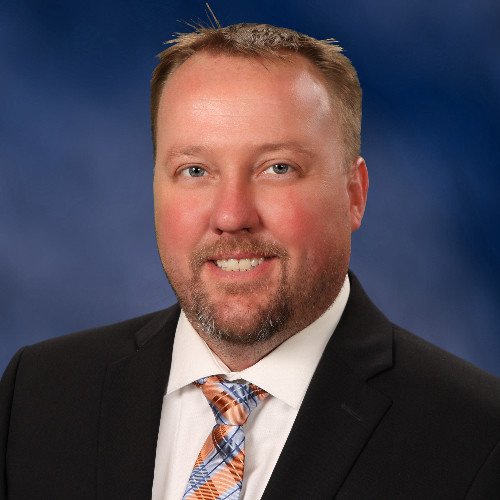
Q: Where are you from? Where did you graduate, and what was your path to the role that you are in now?
Dusty: I grew up on a wooded branch halfway between Stephenville and Possum Kingdom Lake. So, I grew up in rural Texas and graduated from Stephenville High School. From there, I went to Texas Tech, their honors college. My major was English with a specialization in American poetry. And with that degree, you either go to grad school, or you teach—or you end up bartending in Austin. And I went to grad school. I was in a joint degree program, JD / MPA, and I finished my master’s first. I was about halfway through law school at the time—wasn't really enjoying it. From there, I went and sought employment.
Q: Can you elaborate on your history in the region and your experience working in different cities?
Dusty: I think it's important that I didn't go to planning school. I have a master's in public administration with a specialization in city management, so I fell into my first job offer out of grad school, which was McKinney. I was very fortunate to receive that offer, and at the time McKinney was the fastest growing city in the nation, and you get decade’s worth of experience in a year's worth of work. So, I learned development. You get thrown into the fire and you learn development.
A lot of planners are trained in long range planning, maybe for housing policy or community engagement. My specialty in my career has always been focused on hyper-growth communities and development, and that satisfies my itch because I'm fairly impatient and results driven. It allows me to see more immediate impacts of our ordinance updates, and some of our different plans and policies. We can affect change a lot quicker through development, leveraging the development community to help solve some of the problems of your community.
Q: What is a project or something in urban planning that you are presently focused on in Celina?
Dusty: In Celina, we have a lot of projects. We currently have the fastest growing city in the nation with nearly 80 square miles of ultimate growth boundary. That's geographically larger than Plano and Frisco, not by much, but by some. So, we have a lot of purpose right now. For example, our Master Trails Plan—this is just one of a dozen examples—at time of buildout, we'll have the largest trail system in the state of Texas.
So things of that nature, knowing that our neighborhoods will be more sustainable. Our residents, current and future, will have the opportunity to connect with nature, get out. I think that's really neat to know that that's occurring. The same thing as the second ring suburbs learned from the first, and the third, and fourth ring suburbs learn from the others. We're just trying to learn from the past and see if we can do things better, make a better mouse trap.
Q: What big projects are you looking forward to seeing in Celina or greater DFW that you think will have a direct and positive impact on the city or your region?
Dusty: That's a great question. There's a lot of things regionally that have an impact on Celina. Like, we're commuting distance to the 121 DNT corridor area, and that job hub is, to my understanding, the number one job hub in DFW. Even Texoma, potentially, that's commuting distance from Celina. Then, of course, McKinney and Denton as well. So, Celina's well located geographically to access a lot of various job hubs in the region.
Long term, something like the McKinney Airport could potentially have a large impact. And one thing about Celina is that we have 10 miles of frontage on the tollway and Preston, and another eight miles on the outer loop. So, I think the future is bright in terms of what could potentially come our way.
Q: Regarding mobility and transportation, where is Celina heading and what would they like to see in the future?
Dusty: We're kind of experiencing the same pattern that North Dallas has seen for the past 80 years. We have an arterial network on our master thoroughfare plan that's gridded, kind of like Plano, Frisco, McKinney, and we're on the tollway and Outer Loop. So, the question is, is there going to be anything different, technology wise or federal policy wise, or any major paradigm shift that changes the current and historic pattern?
We also have worked with NCTCOG. Someday, we're supposed to be the terminus stop on the line coming north out of Irving, through Carrollton and Frisco and Prosper. So that's really cool to know—it’s possible that Celina has light rail up to downtown. We already have some transit stops identified. Those kinds of things are really neat.
Q: What does your day-to-day look like in your role in Celina?
Dusty: Managing development. We have probably what feels like 10,000 projects in the queue, and we're constantly either trying to push a permit out or get a business open. It's mostly coordinating those efforts. We have a lot of departments that comprise development services— we have building permits, planning, code enforcement—even working very closely with a lot of different various departments in the city: engineering, EDC, GIS, City Manager's Office, City Attorney's Office, and obviously elected and appointed officials as well.
Then of course, you hear from the residents, HOAs, and then the business and development community is constantly in touch. There’re always a lot of stakeholders involved, and it's just juggling that, making sure everybody has a chance to be heard and trying to get these projects constructed in a manner that reflects Celina's values, expectations, and regulations.
Q: Is there a lot of collaboration to be done with the surrounding cities?
Dusty: Usually, more engineering related in terms of infrastructure, roadways and things. But yeah, we have a close working relationship. City government can be a bit of a revolving door. We've all worked in other cities. I started my career in McKinney, went to Little Elm, then Sachse, and now in Celina. And many of the people who work in Celina today usually have worked in other cities before, whether it's Allen, Frisco, Plano, Melissa, Denton, or Sherman. We're not isolated, we're not in a silo. We have the opportunity to learn from our neighbors and our friends.
Q: What makes Celina such a special place and also an important part of the greater DFW region?
Dusty: I think one thing about Celina is that we have a phenomenal downtown. We were fortunate enough to inherit a square with great bones. We have several breweries and wineries and restaurants. We have an amazing town square, which has led to a stronger community spirit and sense of belonging.
Just to give some context, we're roughly 75,000 people today. Our buildout is over 350,000, so that gives you kind of 30, 40 years of growth remaining. I think the future is amazingly bright.
Q: Can you elaborate more on the history and strategy behind having open spaces and trails?
Dusty: One thing that Celina does that's truly unique is that we have a Neighborhood Vision Book, adopted in 2020. There are only maybe a few cities in the entire state that have anything similar. All cities tend to have some open space regulations, like arbitrary percentage based, and they don't really yield quality outcomes.
We went back in the late teens and worked with some consultants to come up with the Neighborhood Vision Book. The goal is to help developers meaningfully incorporate and program open space into our new development so that we're building neighborhoods and not just subdivisions. Now we have a ton of these really cool open areas that are gathering spots—whether they're fire pits or just string lights and lawn chairs—and they're connected by trails. There's a chance for neighbors to meet each other when they're pushing the strollers or in the evenings enjoying a beverage.
Neighborhood design can literally lead to more resilient and higher performing neighborhoods.
Q: For someone young today that wants to get into planning, what education or what skills would you recommend that they have?
Dusty: I think the traditional approach is planning school, but if you look at the best planners, they may be an architect or engineer or a developer or a writer. Planners don't have these scripted backgrounds. If you can get to work in a public agency or even a private firm, you have an opportunity to get in, get plugged in, and I believe that you thrive where you're planted.
I didn't know development before McKinney hired me, and I learned it and developed a passion for it. I think a lot of people expect to make that one right decision. I believe that you make a decision, then you make the decision right through your effort and your attitude.
Get plugged in someplace, learn, be an asset, add value, and over time, you'll develop a career that's hopefully satisfactory and adds value to the rest of the world.
Q: Any last words you would like to share?
Dusty: I'm grateful to be included and have a chance to share and participate. I've spent most of my career being a sponge and learning from those around me, and I think that I still have the same attitude. I appreciate being included and having the chance to participate.